Showing posts with label Reverse Auction. Show all posts

Tuesday, January 17, 2017

Guest Blogger Stephan Sloan: Sick Sigma?

For the Reverse Auction portion of Stage 4 there has been a reassuringly green box and check mark around the First Component of the Final Stage Rule graphic on the Incentive Auction Dashboard. https://auctiondata.fcc.gov/public/projects/1000However, we can learn that the First Component is in fact not met as noted in paragraph 22 of https://apps.fcc.gov/edocs_public/attachmatch/DA-16-1354A1.pdf released back on December 9th. (Thank you again to @Nancy_Drew for this.)

The requirement of the First Condition of the Final Stage Rule is now that there be “market pricing” defined by the FCC as greater than $1.25/MHz/Pop for the top 40 PEAs. If I add up all the bid prices, divide by 10 (MHz) and divide by pops bid for the top 40 markets at the open of Stage 4 I find an average of $1.29. However, that’s not the way it’s done. The equation below is my translation of the FCC formula for calculating the average price:


Calculating in this manner, specifically differentiating between the sale of blocks with demand and those supplied seems to cause the Final Stage Rule to seek a market price for both the blocks sold and those unsold. I would not have anticipated unsubscribed blocks in the top 40 PEAs and yet that is the case in both Los Angeles and San Diego. Carrying the weight of those goose eggs in the equation is heavy. These un-bid blocks represent perhaps the simplest and I believe the most efficient way to satisfy the First Condition of the Final Stage Rule. Bids for an additional block at present pricing in both Los Angeles and San Diego would cost $441,486,000 and require a bidder or bidders with 23,300 available bidding units. Both of these requirements are less than the amounts eliminated in the New York PEA by the progression from Stage 3 to Stage 4. The resulting average of $1.2533…. overshoots the rule. Alternatively, without further demand in Los Angeles and San Diego, if pricing were to advance to the Clock Price in each of New York, Chicago, San Francisco, Baltimore, Philadelphia, Boston, Dallas and Miami it would cost bidders $400,905,540 to achieve $1.2501… While this path costs fewer dollars it also represents two fewer blocks of spectrum licensed and therefore, I believe, is less efficient.

I have confidence the spectrum offered in the Forward Auction is very valuable and the current Incentive Auction process is not establishing its market value but instead answering the question at what price will the previously approved bidders accept this amount of spectrum reallocated from broadcast to broadband use. The data for supply and price thus far I believe supports this. The following chart presents the progression in pricing (I continued the Stage 1 round count through successive Stages for the x-axis) along with the number of blocks of spectrum supplied.
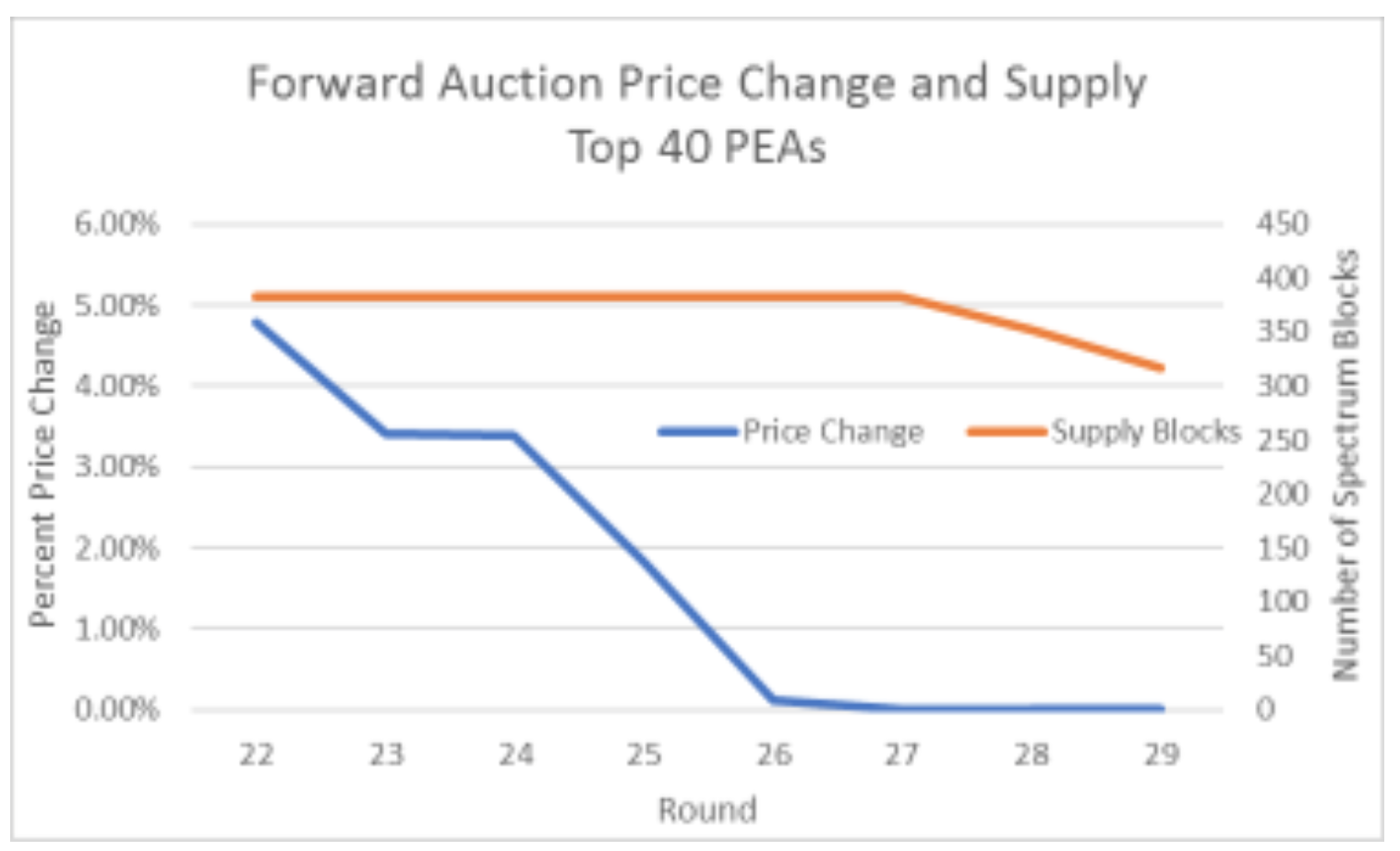

The rapid progression of Stages has clearly illustrated how compressible demand is for blocks in the top 40 PEAs. As supply is removed from all PEAs, demand has dropped nearly in step. This is reflected in the following chart presenting aggregate supply and aggregate demand in blocks for each stage. (I have focused my analysis on C1 or unimpaired blocks.)


Demand in markets smaller than the top 40 has percolated up marginally.


I keep in mind that 75% of all demand units in the Forward Auction are represented in the top 40 PEAs. This analysis also seems to put lie to any claim that there is a pool of demand displaced from the top 40 PEAs by the recent Stage progressions that is loitering outside the top 40 PEAs causing the auction to advance but waiting for some as of yet unoccasioned event to reintroduce itself and drive pricing up in the top markets.

Demand has deserted the Forward Auction almost as quickly as the FCC has constrained supply. The theory of displaced demand in larger or different PEAs reintroducing itself to accept supply or push pricing on other/smaller PEAs I have not found supported in the data. Perhaps this auction has been long enough and this winter has been cold enough that some of the demand from the Northeast will find its way to lovely Southern California and one of those unsubscribed LA and San Diego blocks.

Paragraph 22 of the Public Notice I cited at the start concludes with, “…approximately three cents short of the required $1.25 benchmark.”. This is perfect Incentive Auction prose as there is a footnote indicating, “The auction system neither rounds nor truncates the average price when determining whether the first component of the final stage rule has been met.” Three cents are, in fact, the path to Stage 5. I believe $441,846,000 or even a little less can get it done now.

401.454.3130


Wednesday, June 29, 2016

Guest Blogger Stephan Sloan: Bigger Than Big

$86,422,558,704

That looks like $2.71/MHz/Pop.

I didn't have the optimism to model that there would be reserve price discipline of the middle and smaller TV station owners to support this. The message I see in this information is that the TV broadcasters have participated fully in the FCC's plan and the spectrum is valuable to them. I also see an effect from the consolidation in the Television business as the larger broadcasters had the time and talent to determine optimal yield analysis and bidding strategies. While I remain surprised by the total I believe there is substantial data to support validation from the Forward Auction.

Before recoiling at that clearing cost please consider the quote below from Peter Compton in commenting on the results of the AWS3 Auction back in May of 2015.

"The nationwide average price for the paired blocks was $2.72/MHzPop, about three times higher than investment banking estimates before the auction began."

Stephan Sloan 
Director, Media Service Group
401.454.3130
ss@mediaservicesgroup.com

Tuesday, June 28, 2016

Guest Blogger Stephan Sloan: The Big Big Number

I tipped my hand with my LinkedIn post on June 1st "The $40 Billion Blink" as to what sort of capital I thought would be required to clear 126 MHz in the Reverse Auction.

George Box famously observed that all models are wrong but some are useful. In this spirit I accept that my models are wrong but none the less support and illustrate reality. Though many of the industry professionals I respect have opined at much lower Reverse Auction clearing costs, I expect $58 Billion or greater. The histogram below presents the data from 99 iterations modeling the Reverse Auction.

What this data means is that I can construct models that indicate a high probability that the clearing cost is more than $58 Billion and costs exceeding $60 Billion are a significant possibility. This represents a range of approximately $1.72 to $1.93 /MHz/Pop. If you accept the idea that the first round of the auction evidenced stations freezing based upon the requirement to meet the maximum possible clearing target, then we were bound from the moment the clearing target was announced, to end up here.

$58 Billion also has an additional significance to those of you following my LinkedIn postings. I’ve enjoyed very much the opportunity to post these thoughts and your responses. For my contacts who would like to take me up on it, I will wager a steak dinner– at the restaurant of your choosing- that the clearing cost will exceed $58 Billion. $57,999,999,999.99 or lower and it’s on me, just memorialize your interest in an email, tweet, LinkedIn Message or other dated communication before the FCC releases the data. I think a good reference should be the Incentive Auction dashboard.

I’ve been focused on this level of clearing cost since 126 MHZ was announced on April 29th. I look forward to discussing how this value is validated in the Forward Auction.

Wednesday, June 22, 2016

Guest Blogger Stephan Sloan: Moving Day

This week's progress in the Reverse Auction includes the rounds in which stations will become frozen in much greater numbers than in the previous weeks' activity. I anticipate that somewhere around 300 television stations will be frozen in the auction in rounds 31 through 45. 

While the last week's rounds illustrated the price decrement in relation to opening bid, this week makes clear the diminished bids in terms of dollars. Round 31's activity is expected to yield an average of $68 million freeze price with a high of $108 million and a low of $16 million (a Class A station). At the week's expected ending round 45, the freeze prices are down to an average of $8 million with a high of $13 million and a low of $5 million. The following chart illustrates the declining freeze prices by stations and round. 


Considering the post-auction scarcity of television stations, especially UHF channels, it is hard to imagine many markets where this level of pricing is not a significant discount to what will be available to station owners post auction. 

Since the Round 21-22 delay, the bidding appears to have progressed smoothly. From what we have observed so far I do not anticipate additional delays and am impressed with the FCC staff's ability to conduct, process, report and repeat the bidding rounds. 

Finishing this week on schedule leaves short work for next week to conclude the Reverse Auction. Soon we will find out what will be required to validate this auction in the Forward Auction. 

Stephan Sloan
Director, Media Services Group
401.454.3130
ss@mediaservicesgroup.com