Showing posts with label FCC. Show all posts
Showing posts with label FCC. Show all posts
Thursday, April 13, 2017
FCC Announces TV Station Winners in the Spectrum Auction
Click for the list: http://transition.fcc.gov/Daily_Releases/Daily_Business/2017/db0413/DA-17-314A2.pdf


Tuesday, January 17, 2017
Guest Blogger Stephan Sloan: Sick Sigma?
For the Reverse Auction portion of Stage 4 there has been a reassuringly green box and check mark around the First Component of the Final Stage Rule graphic on the Incentive Auction Dashboard. https://auctiondata.fcc.gov/public/projects/1000However, we can learn that the First Component is in fact not met as noted in paragraph 22 of https://apps.fcc.gov/edocs_public/attachmatch/DA-16-1354A1.pdf released back on December 9th. (Thank you again to @Nancy_Drew for this.)
The requirement of the First Condition of the Final Stage Rule is now that there be “market pricing” defined by the FCC as greater than $1.25/MHz/Pop for the top 40 PEAs. If I add up all the bid prices, divide by 10 (MHz) and divide by pops bid for the top 40 markets at the open of Stage 4 I find an average of $1.29. However, that’s not the way it’s done. The equation below is my translation of the FCC formula for calculating the average price:


The requirement of the First Condition of the Final Stage Rule is now that there be “market pricing” defined by the FCC as greater than $1.25/MHz/Pop for the top 40 PEAs. If I add up all the bid prices, divide by 10 (MHz) and divide by pops bid for the top 40 markets at the open of Stage 4 I find an average of $1.29. However, that’s not the way it’s done. The equation below is my translation of the FCC formula for calculating the average price:
Calculating in this manner, specifically differentiating between the sale of blocks with demand and those supplied seems to cause the Final Stage Rule to seek a market price for both the blocks sold and those unsold. I would not have anticipated unsubscribed blocks in the top 40 PEAs and yet that is the case in both Los Angeles and San Diego. Carrying the weight of those goose eggs in the equation is heavy. These un-bid blocks represent perhaps the simplest and I believe the most efficient way to satisfy the First Condition of the Final Stage Rule. Bids for an additional block at present pricing in both Los Angeles and San Diego would cost $441,486,000 and require a bidder or bidders with 23,300 available bidding units. Both of these requirements are less than the amounts eliminated in the New York PEA by the progression from Stage 3 to Stage 4. The resulting average of $1.2533…. overshoots the rule. Alternatively, without further demand in Los Angeles and San Diego, if pricing were to advance to the Clock Price in each of New York, Chicago, San Francisco, Baltimore, Philadelphia, Boston, Dallas and Miami it would cost bidders $400,905,540 to achieve $1.2501… While this path costs fewer dollars it also represents two fewer blocks of spectrum licensed and therefore, I believe, is less efficient.
I have confidence the spectrum offered in the Forward Auction is very valuable and the current Incentive Auction process is not establishing its market value but instead answering the question at what price will the previously approved bidders accept this amount of spectrum reallocated from broadcast to broadband use. The data for supply and price thus far I believe supports this. The following chart presents the progression in pricing (I continued the Stage 1 round count through successive Stages for the x-axis) along with the number of blocks of spectrum supplied.
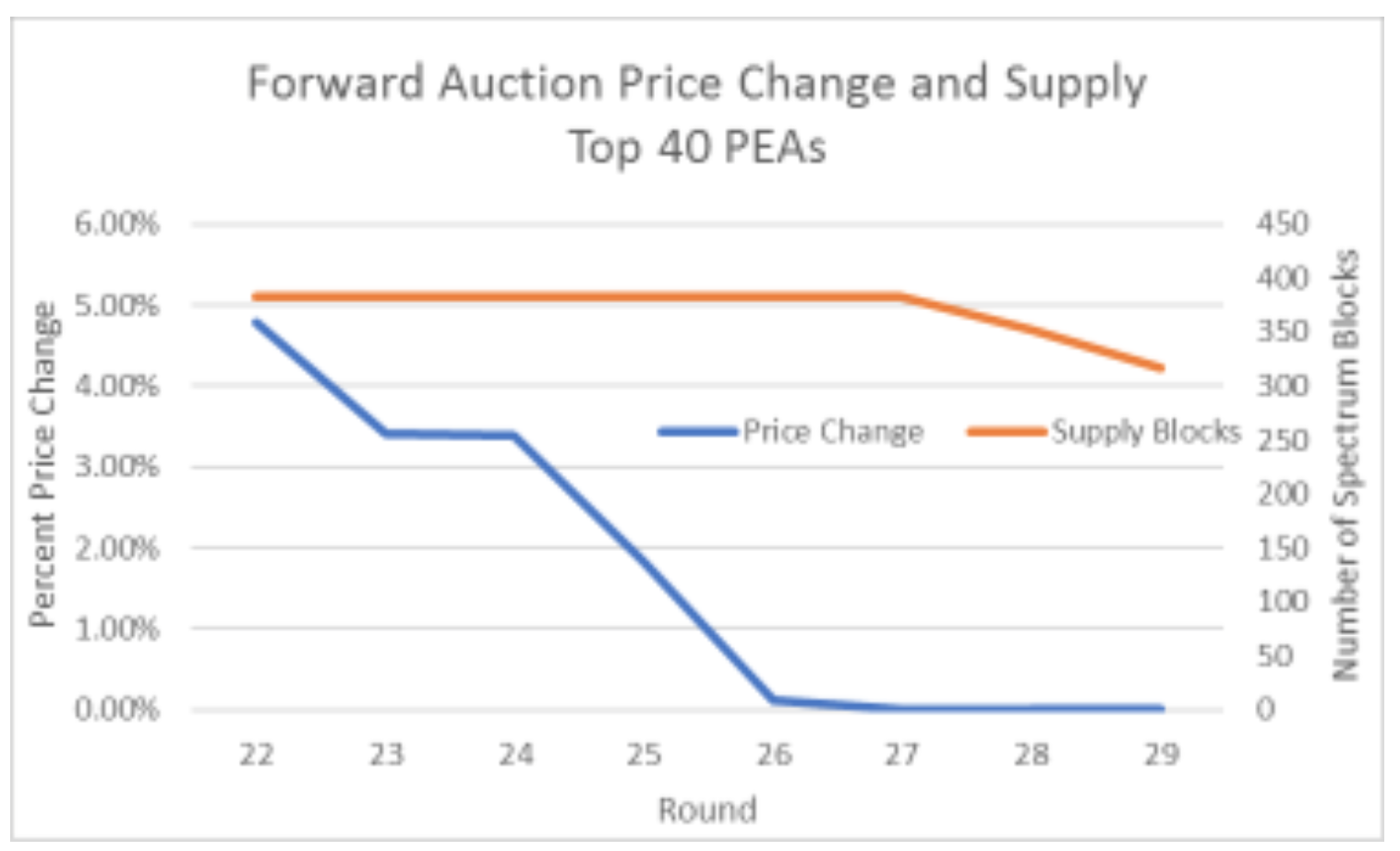
The rapid progression of Stages has clearly illustrated how compressible demand is for blocks in the top 40 PEAs. As supply is removed from all PEAs, demand has dropped nearly in step. This is reflected in the following chart presenting aggregate supply and aggregate demand in blocks for each stage. (I have focused my analysis on C1 or unimpaired blocks.)

Demand in markets smaller than the top 40 has percolated up marginally.

I keep in mind that 75% of all demand units in the Forward Auction are represented in the top 40 PEAs. This analysis also seems to put lie to any claim that there is a pool of demand displaced from the top 40 PEAs by the recent Stage progressions that is loitering outside the top 40 PEAs causing the auction to advance but waiting for some as of yet unoccasioned event to reintroduce itself and drive pricing up in the top markets.
Demand has deserted the Forward Auction almost as quickly as the FCC has constrained supply. The theory of displaced demand in larger or different PEAs reintroducing itself to accept supply or push pricing on other/smaller PEAs I have not found supported in the data. Perhaps this auction has been long enough and this winter has been cold enough that some of the demand from the Northeast will find its way to lovely Southern California and one of those unsubscribed LA and San Diego blocks.
Paragraph 22 of the Public Notice I cited at the start concludes with, “…approximately three cents short of the required $1.25 benchmark.”. This is perfect Incentive Auction prose as there is a footnote indicating, “The auction system neither rounds nor truncates the average price when determining whether the first component of the final stage rule has been met.” Three cents are, in fact, the path to Stage 5. I believe $441,846,000 or even a little less can get it done now.
Director, Media Services Group
401.454.3130
Thursday, January 12, 2017
Guest Blogger Stephan Sloan: One Round with the Champ

When the results of Stage 2 were published, I was considering the probability of validating the Incentive Auction if the Forward Auction continued to fail at advancing the Auction Proceeds. The chart above indicates the outcomes of some models I was considering. The outcome of Stage 3 validated these models and increased my interest in their Stage 4 prediction. Perhaps only in a federal US government adventure can a $4 Billion spread (implied in Stage 4 data above) appear as tantalizingly close.
Throughout the Incentive Auction process, I believe reserve prices have been a moving target. For many, calculation of reserve prices rose as the prospect of being frozen in the auction became more real and proximate in their minds. For the first two Stages the perception of the expense of winding down their business or porting it to another channel grew. The measured but significant increase in Stage 3 Reverse Auction competition may have added the concept of relative reserve price to the mix. Concerns of underestimating the expense of winning (freezing) gave way to assessment of the probability of winning.
Stage 4 surely has added to the strain of reserve price discipline for station owners with the model no-longer finding any support from scarcity of participation and seeking the exit of multiple participants in many markets. It is this strain that is causing me to discount the previously reliable model charted above and consider the possibility of starting the Stage 4 Forward Auction with the Final Stage Rule met.
Reserve price discipline may be the greatest test of the Reverse Auction. Without respect to the thoughtfulness or conviction with which one may arrive at a reserve price actually sticking to it is another matter. At the peak of his career, Mike Tyson was apprised by a reporter that his next opponent had a plan to defeat the champ. Tyson’s reply echoed Joe Louis’s answer to a similar question a generation before when he quipped, “Everybody’ has a plan until they get punched in the mouth.” For many station owners, whose experience in Stages 1-3 was one of delight with the outcome, the approximation and arrival at their anticipated reserve price over the past few days has no doubt been as unpleasant as a punch in the mouth.
There is genius too in the design of the Reverse Auction as bidders are provided a Vacancy Index which is quite good for the pinning of hopes if not otherwise useless for a single station owner. The transition to 1% decrements and the option to accept a “free” VHF station further the virtual suction down the rounds. These elements introduce quicksand on what looked like firm ground from round 10 of the Stage.
This sentiment is compelling me towards expecting an end of the auction at Stage 4.
Note: I made an incorrect statement about the Final Stage Rule in an earlier version of this post. I removed the mistake from this version and am working to understand a recent FCC post.
If a silver lining can be found for the decrease in station pricing to achieve validation at Stage 4 it is a less is more argument. Lower pricing in this Stage permits the model to include more stations (by not progressing to an additional Stage). I believe a progression from Stage 4 to 5 of the Reverse Auction represents nearly a fully reserve price supported model and accordingly further reductions in clearing costs are mostly accomplished by taking fewer stations and not decrementing the prices of the stations bidding. The chart below presents data for models estimating the number of stations frozen in the auction. The number indicates the average number of stations frozen in the models I chose and the size of the bubble represents the variance among the models.

We will very shortly know exactly how many stations are frozen and the aggregate value of those stations. As always, I look forward to your comments and the opportunity to discuss these observations.
Stephan Sloan
Director, Media Services Group
401.454.3130
ss@mediaservicesgroup.com
Tuesday, December 20, 2016
Guest Blogger Stephan Sloan: Contest Rules
Few tournaments have rules for those no longer competing. The Incentive Auction does in the form of 47 C.F.R. § 1.2205(c), the Prohibited Communications Rule. For more than 800 stations not needed in Stage 1 the price of entering the tournament is the continuing burden of the Prohibited Communications Rule. Station owners interested in exploring the sale of their station are presently challenged to provide information to prospective buyers concerned that they will be thought to be communicating elements of their bidding strategy or outcome inthe auction. Buyers are dubious of the effort or resources they should expend to pursue a station which could be frozen in the auction.
I have been pleased to support efforts to identify stations that should be waived from this rule as they no longer represent meaningful data for rational models of auction outcomes in the current and later Stages. I remain hopeful that recognition of the public good for the purposes of community service and repack as well as the negligible value to the remaining competitors will guide the FCC to a relaxation or limitation of the Prohibited Communications Rule.
For those wishing to pursue the purchase of a station that elected to participate in the Incentive Auction I can offer data on the probability of a station being frozen. Good modeling provides buyers a rational understanding of the probability a station was frozen in the Incentive Auction and on that basis, decide if they should pursue it or not. Buyers can make their own assessment without input from the station owner, honoring the Prohibited Communications Rule.
We are clearly past halftime in the Incentive Auction tournament. Like in the final quarter of a game, I think the highest stakes calls are being made now in Stage 4. Notre Dame football coach Lou Holtz encouraged his players; “How you respond to the challenge in the second half will determine what you become after the game.” I hope I can assist some of you or your clients with successful answers to these challenges.
Director, Media Services Group
401.454.3130
Monday, December 19, 2016
Guest Blogger Stephan Sloan: Tournament Television
The Incentive Auction is looking more like a tournament than an auction to me.
In the early stages of the Incentive Auction the perception of winning this tournament, that is receiving more value for your television license than it was otherwise worth, was probable for many stations. Licensees who were allowed to participate piled in to the contest and expected a victory. This behavior can be seen as the success of the opening bid prices and the distribution accomplished by the FCC and the Greenhill Report.
Like in tournaments, participants’ assessment of victory evolves as time elapses. The huge spread between the Stage 1 Clearing Target and Net Auction Proceeds was a strong indication to competitors that multiple stage progressions would be likely to close that gap. Many models pointed towards Stage 4 as the first opportunity for validation.
For a participant, anticipation of a Stage 4 result yields a radically different expectation of winning both in terms of probability and magnitude. It can be modeled that 270+ fewer stations are frozen by Stage 4 and the amounts paid to the winning licensees is reduced by more than 70%. The tournament by Stage 4 is a different contest. Without confidence, the Incentive Auction of Stage 4 does not create hope for winning but raises the question what does loosing look like?
I believe that as the stages have progressed many television station owners have turned away from further assessment of their reserve price (a metric for winning) and have focused instead on post Incentive Auction plans. To illustrate this point, Stage 1 results promised each of two or more duopoly owners in a market a winning scenario of each of them freezing one station in the auction and receiving a generous sum of money, participation in the tournament is rational. After the auction, each of the duopoly owners could be winners and the competitive landscape in the market would remain as each duopoly would likely now be represented by a single station (and a large bag of cash).
Stage 4 likely presents asymmetric results where all of the stations offered by the duopoly operators would not be needed. Outcomes include some duopolies remaining intact while another may freeze a station. Is a definition of winning being the only duopoly to freeze and facing post Incentive Auction competition with half the bandwidth of the competition (and a smaller bag of cash)? Pricing this scenario is complicated as well where reserve prices become relative to the competition rather than a function of enterprise value.
How do you like the tournament so far?
Stephan Sloan
Director, Media Services Group
401.454.3130
ss@mediaservicesgroup.com
In the early stages of the Incentive Auction the perception of winning this tournament, that is receiving more value for your television license than it was otherwise worth, was probable for many stations. Licensees who were allowed to participate piled in to the contest and expected a victory. This behavior can be seen as the success of the opening bid prices and the distribution accomplished by the FCC and the Greenhill Report.
Like in tournaments, participants’ assessment of victory evolves as time elapses. The huge spread between the Stage 1 Clearing Target and Net Auction Proceeds was a strong indication to competitors that multiple stage progressions would be likely to close that gap. Many models pointed towards Stage 4 as the first opportunity for validation.
For a participant, anticipation of a Stage 4 result yields a radically different expectation of winning both in terms of probability and magnitude. It can be modeled that 270+ fewer stations are frozen by Stage 4 and the amounts paid to the winning licensees is reduced by more than 70%. The tournament by Stage 4 is a different contest. Without confidence, the Incentive Auction of Stage 4 does not create hope for winning but raises the question what does loosing look like?
I believe that as the stages have progressed many television station owners have turned away from further assessment of their reserve price (a metric for winning) and have focused instead on post Incentive Auction plans. To illustrate this point, Stage 1 results promised each of two or more duopoly owners in a market a winning scenario of each of them freezing one station in the auction and receiving a generous sum of money, participation in the tournament is rational. After the auction, each of the duopoly owners could be winners and the competitive landscape in the market would remain as each duopoly would likely now be represented by a single station (and a large bag of cash).
Stage 4 likely presents asymmetric results where all of the stations offered by the duopoly operators would not be needed. Outcomes include some duopolies remaining intact while another may freeze a station. Is a definition of winning being the only duopoly to freeze and facing post Incentive Auction competition with half the bandwidth of the competition (and a smaller bag of cash)? Pricing this scenario is complicated as well where reserve prices become relative to the competition rather than a function of enterprise value.
How do you like the tournament so far?
Stephan Sloan
Director, Media Services Group
401.454.3130
ss@mediaservicesgroup.com
Wednesday, June 29, 2016
Guest Blogger Stephan Sloan: Bigger Than Big
$86,422,558,704
That looks like $2.71/MHz/Pop.
I didn't have the optimism to model that there would be reserve price discipline of the middle and smaller TV station owners to support this. The message I see in this information is that the TV broadcasters have participated fully in the FCC's plan and the spectrum is valuable to them. I also see an effect from the consolidation in the Television business as the larger broadcasters had the time and talent to determine optimal yield analysis and bidding strategies. While I remain surprised by the total I believe there is substantial data to support validation from the Forward Auction.
Before recoiling at that clearing cost please consider the quote below from Peter Compton in commenting on the results of the AWS3 Auction back in May of 2015.
"The nationwide average price for the paired blocks was $2.72/MHzPop, about three times higher than investment banking estimates before the auction began."
Stephan Sloan
Director, Media Service Group
401.454.3130
ss@mediaservicesgroup.com
That looks like $2.71/MHz/Pop.
I didn't have the optimism to model that there would be reserve price discipline of the middle and smaller TV station owners to support this. The message I see in this information is that the TV broadcasters have participated fully in the FCC's plan and the spectrum is valuable to them. I also see an effect from the consolidation in the Television business as the larger broadcasters had the time and talent to determine optimal yield analysis and bidding strategies. While I remain surprised by the total I believe there is substantial data to support validation from the Forward Auction.
Before recoiling at that clearing cost please consider the quote below from Peter Compton in commenting on the results of the AWS3 Auction back in May of 2015.
"The nationwide average price for the paired blocks was $2.72/MHzPop, about three times higher than investment banking estimates before the auction began."
Stephan Sloan
Director, Media Service Group
401.454.3130
ss@mediaservicesgroup.com
Tuesday, June 28, 2016
Guest Blogger Stephan Sloan: The Big Big Number
I tipped my hand with my LinkedIn post on June
1st "The $40 Billion Blink" as to what sort of capital
I thought would be required to clear 126 MHz in the Reverse Auction.
George Box famously observed that all models are wrong but some are useful. In this spirit I accept that my models are wrong but none the less support and illustrate reality. Though many of the industry professionals I respect have opined at much lower Reverse Auction clearing costs, I expect $58 Billion or greater. The histogram below presents the data from 99 iterations modeling the Reverse Auction.

George Box famously observed that all models are wrong but some are useful. In this spirit I accept that my models are wrong but none the less support and illustrate reality. Though many of the industry professionals I respect have opined at much lower Reverse Auction clearing costs, I expect $58 Billion or greater. The histogram below presents the data from 99 iterations modeling the Reverse Auction.

What this data means is
that I can construct models that indicate a high probability that the clearing
cost is more than $58 Billion and costs exceeding $60 Billion are a significant
possibility. This represents a range of approximately $1.72 to $1.93 /MHz/Pop.
If you accept the idea that the first round of the auction evidenced stations
freezing based upon the requirement to meet the maximum possible clearing
target, then we were bound from the moment the clearing target was announced,
to end up here.
$58 Billion also has an additional significance to those of you following my LinkedIn postings. I’ve enjoyed very much the opportunity to post these thoughts and your responses. For my contacts who would like to take me up on it, I will wager a steak dinner– at the restaurant of your choosing- that the clearing cost will exceed $58 Billion. $57,999,999,999.99 or lower and it’s on me, just memorialize your interest in an email, tweet, LinkedIn Message or other dated communication before the FCC releases the data. I think a good reference should be the Incentive Auction dashboard.
I’ve been focused on this level of clearing cost since 126 MHZ was announced on April 29th. I look forward to discussing how this value is validated in the Forward Auction.
$58 Billion also has an additional significance to those of you following my LinkedIn postings. I’ve enjoyed very much the opportunity to post these thoughts and your responses. For my contacts who would like to take me up on it, I will wager a steak dinner– at the restaurant of your choosing- that the clearing cost will exceed $58 Billion. $57,999,999,999.99 or lower and it’s on me, just memorialize your interest in an email, tweet, LinkedIn Message or other dated communication before the FCC releases the data. I think a good reference should be the Incentive Auction dashboard.
I’ve been focused on this level of clearing cost since 126 MHZ was announced on April 29th. I look forward to discussing how this value is validated in the Forward Auction.
Stephan Sloan
Director, Media Services Group
401.454.3130
ss@mediaservicesgroup.com
Director, Media Services Group
401.454.3130
ss@mediaservicesgroup.com
Wednesday, June 22, 2016
Guest Blogger Stephan Sloan: Moving Day
This week's progress in the Reverse Auction includes the rounds in which stations will become frozen in much greater numbers than in the previous weeks' activity. I anticipate that somewhere around 300 television stations will be frozen in the auction in rounds 31 through 45.

While the last week's rounds illustrated the price decrement in relation to opening bid, this week makes clear the diminished bids in terms of dollars. Round 31's activity is expected to yield an average of $68 million freeze price with a high of $108 million and a low of $16 million (a Class A station). At the week's expected ending round 45, the freeze prices are down to an average of $8 million with a high of $13 million and a low of $5 million. The following chart illustrates the declining freeze prices by stations and round.

Considering the post-auction scarcity of television stations, especially UHF channels, it is hard to imagine many markets where this level of pricing is not a significant discount to what will be available to station owners post auction.
Since the Round 21-22 delay, the bidding appears to have progressed smoothly. From what we have observed so far I do not anticipate additional delays and am impressed with the FCC staff's ability to conduct, process, report and repeat the bidding rounds.
Finishing this week on schedule leaves short work for next week to conclude the Reverse Auction. Soon we will find out what will be required to validate this auction in the Forward Auction.
Stephan Sloan
Director, Media Services Group
401.454.3130
ss@mediaservicesgroup.com
Stephan Sloan
Director, Media Services Group
401.454.3130
ss@mediaservicesgroup.com
Wednesday, June 15, 2016
Guest Blogger Stephan Sloan: Out of the Doldrums
I believe the Reverse Auction's relative doldrums of the past week will ease this week. As is the way with doldrums though, it's almost assured that the change will be incremental. Don't expect any thunder claps; I do not believe that's the way of this algorithm with my assumptions. Just as the preceding rounds were characterized by not much going on, the present rounds will have limited stimulus and that will place modest demands on the algorithm to freeze additional stations. The chart below presents potential data for the number of stations frozen in the auction for the rounds to be conducted this week. In this model approximately 80 stations are frozen for a value of slightly over $6 Billion.

At the close of business on Monday, June 13th, with the completion of the 19th round of the auction, the current bids will have dropped just below 40% of the opening bids. For many network affiliates and stations with strong business plans the ride ends now as they are more valuable to their owners than the auction price. By the end of the week the bid prices will have decremented to approximately 25% of the opening bid.
These rounds may be where the smart speculators get rewarded. If a speculator or station owner was not fortunate enough to be in the participation constrained first round of freezing activity, the next best prospect for them would be to hold a station keystoned among other stations with significantly higher reserves than their own. In this example the round a station is frozen results not from the reserve price of the station itself but rather the algorithm exhausting other options for repacking given the higher valued neighboring stations dropping out. So I suppose some owners are tuned in -- turned on -- and hoping everybody else will hurry up and drop out.
Stephan Sloan
Director, Media Services Group
401.454.3130
ss@mediaservicesgroup.com

At the close of business on Monday, June 13th, with the completion of the 19th round of the auction, the current bids will have dropped just below 40% of the opening bids. For many network affiliates and stations with strong business plans the ride ends now as they are more valuable to their owners than the auction price. By the end of the week the bid prices will have decremented to approximately 25% of the opening bid.
These rounds may be where the smart speculators get rewarded. If a speculator or station owner was not fortunate enough to be in the participation constrained first round of freezing activity, the next best prospect for them would be to hold a station keystoned among other stations with significantly higher reserves than their own. In this example the round a station is frozen results not from the reserve price of the station itself but rather the algorithm exhausting other options for repacking given the higher valued neighboring stations dropping out. So I suppose some owners are tuned in -- turned on -- and hoping everybody else will hurry up and drop out.
Stephan Sloan
Director, Media Services Group
401.454.3130
ss@mediaservicesgroup.com
Monday, June 13, 2016
Guest Blogger Stephan Sloan: 57 Channels and Nothing On
After the shock and awe that I believe was the initial round of the auction my expectations of the subsequent rounds are very different.
The algorithmic alchemy resulting from the pressure between solving for the highest clearing target possible given the participation will likely have spent its influence by the end of the first round. The following rounds will decrement steadily seeking a new level of scarcity supported not by participation but rather reserve prices that cause the process to repack those stations with the highest reserves and then seek to order and select among the remaining open bids.
I believe it unlikely that any additional stations were frozen last week after the initial round. While not completely without event I predict that fewer than 50 stations will be frozen during the rounds accomplished and scheduled for this week.
My analysis is based upon an assumption that the algorithm will find the little pressure or few reserve prices at very high percentages of the opening bid price. In addition, I believe there is significant population of stations for which the sum of enterprise value and wind-down costs are a very small percentage of opening bid price. Observing a sample of some 1,200+ stations which I model to participate in the Reverse Auction the average reserve price is only about 15% of the opening bid. While an average of this population may be misleading given its variety of participants it does help illustrate a population of reserve prices that significantly skew towards the later rounds of the Reverse Auction. The histogram that follows present distribution of reverse prices from this sample set of stations.

So if this week feels a little boring for as extraordinary event as the Reverse Auction is, it' snot you - it's the math. Math is often boring.
Stephan Sloan
Director, Media Services Group
401.454.3130
ss@mediaservicesgroup.com
The algorithmic alchemy resulting from the pressure between solving for the highest clearing target possible given the participation will likely have spent its influence by the end of the first round. The following rounds will decrement steadily seeking a new level of scarcity supported not by participation but rather reserve prices that cause the process to repack those stations with the highest reserves and then seek to order and select among the remaining open bids.
I believe it unlikely that any additional stations were frozen last week after the initial round. While not completely without event I predict that fewer than 50 stations will be frozen during the rounds accomplished and scheduled for this week.
My analysis is based upon an assumption that the algorithm will find the little pressure or few reserve prices at very high percentages of the opening bid price. In addition, I believe there is significant population of stations for which the sum of enterprise value and wind-down costs are a very small percentage of opening bid price. Observing a sample of some 1,200+ stations which I model to participate in the Reverse Auction the average reserve price is only about 15% of the opening bid. While an average of this population may be misleading given its variety of participants it does help illustrate a population of reserve prices that significantly skew towards the later rounds of the Reverse Auction. The histogram that follows present distribution of reverse prices from this sample set of stations.

So if this week feels a little boring for as extraordinary event as the Reverse Auction is, it' snot you - it's the math. Math is often boring.
Stephan Sloan
Director, Media Services Group
401.454.3130
ss@mediaservicesgroup.com
Tuesday, June 7, 2016
Guest Blogger Stephan Sloan: The $40 Billion Blink
Tuesday quietly marked a most remarkable day in television station trading history. From models developed with my own assumptions, I believe the initial moment of the FCC Reverse Auction saw approximately 115 stations frozen at a valuation in excess of $40 Billion.
For reference, if one sums all of the television stations sold from 2003 through 2014, inclusive of merger activity, it approximates the value of that one first moment of the auction. I appreciate that this estimate of the first round of the auction exceeds the total value of the Reverse Auction published by many respected entities; however, I have confidence in this estimate as I believe it to be the natural result of the function of the auction algorithm and the legislation causing the entire Reverse and Forward Auction spectacle.
With the requirement of the FCC to attempt the clearance of the maximum bandwidth for which there is participation by broadcasters, we were nearly certain to set the auction algorithm to solve a scenario where there was scarcity of participation among the most valuable stations in the nation. In this initial moment of the auction that scarcity required the freezing of stations at their opening bid with a swath of the northeast consuming $10+ Billion and the mid-Atlantic as well as Southern California taking $8 Billion each.
In terms of the Reverse Auction model, as I see it, we have accomplished the “head” of this freezing activity and will next set about the much more time consuming business of defining the long tail.
Stephan Sloan
Director, Media Services Group
401.454.3130
ss@mediaservicesgroup.com
For reference, if one sums all of the television stations sold from 2003 through 2014, inclusive of merger activity, it approximates the value of that one first moment of the auction. I appreciate that this estimate of the first round of the auction exceeds the total value of the Reverse Auction published by many respected entities; however, I have confidence in this estimate as I believe it to be the natural result of the function of the auction algorithm and the legislation causing the entire Reverse and Forward Auction spectacle.
With the requirement of the FCC to attempt the clearance of the maximum bandwidth for which there is participation by broadcasters, we were nearly certain to set the auction algorithm to solve a scenario where there was scarcity of participation among the most valuable stations in the nation. In this initial moment of the auction that scarcity required the freezing of stations at their opening bid with a swath of the northeast consuming $10+ Billion and the mid-Atlantic as well as Southern California taking $8 Billion each.
In terms of the Reverse Auction model, as I see it, we have accomplished the “head” of this freezing activity and will next set about the much more time consuming business of defining the long tail.
Stephan Sloan
Director, Media Services Group
401.454.3130
ss@mediaservicesgroup.com
Monday, July 1, 2013
Another FAQ: How long does the sale process take?
Q: "How long does the station sale process take?"
A: Often, preparing the due diligence information prior to the marketing of the station(s) is one of the most time-consuming steps of a sale.
Most station marketing agreements with media brokers call for a duration of six to eighteen months, with twelve months being typical.
Time on the market varies. Like real estate, stations that are priced more closely to their Fair Market Value tend to sell the quickest.
The FCC approval process generally takes 60-90 days, with the Staff approval becoming “final” in an additional 40 days. Any objections can delay the process.
George
Media Services Group
Friday, July 8, 2011
Big FCC news out of the 3rd Circuit on media cross-ownership
A U.S. appeals court vacated an FCC rule relaxing limits on cross-ownership. The ruling marks the second time the appeals court has intervened in the commission’s attempts to relax media ownership rules.
Here's the story from Bloomberg: CLICK HERE
Have a great weekend,
George
Media Services Group
Here's the story from Bloomberg: CLICK HERE
Have a great weekend,
George
Media Services Group
Monday, November 29, 2010
Great article in RBR on the FCC assignment and transfer process
Today's RBR ran a great article on the FCC transaction approval process. Erwin Krasnow, preeminent FCC attorney, interviewed the FCC's Taft Snowdon, Supervisory Attorney, Audio Division, Media Bureau. Thanks to my partner Bob Heymann for calling it to my attention.
Click HERE for the link.
George
Media Services Group
Click HERE for the link.
George
Media Services Group
Thursday, August 19, 2010
A number of broadcasters support the AM/FM Subcaps
A number of broadcasters teamed up to file reply comments with the FCC seeking repeal of the AM/FM subcaps on July 26. The coalition represents some 668 stations in markets of all sizes. My two broadcasting companies (Monticello Media and MSG Radio) as well as our brokerage firm signed onto the comments.
If the subcaps are repealed, it will result in new capital coming into our capital starved industry. I predict that a number of broadcasting companies may be saved from bankruptcy if the subcaps are removed on a timely basis.
The subcaps are no longer (if ever) justified. You can read the details in the Reply Comments. Essentially, if you operate in a market where ownership of four FMs and two AMs is allowed (or four AMs and two FMs), the removal of the subcaps would allow you to own six stations, regardless of flavor. If they are repealed, unprofitable clusters can swap/trade/buy/sell and improve their strategic and financial positions.
Repealing the subcaps will awaken a stagnant industry, introduce fresh capital, and open doors for new minority ownership. Let's hope that the FCC sees the wisdom of eliminating an antiquated burden on broadcasters.
Click here for the filing: Reply Comments
That is my opinion. What is yours?
George
Media Services Group
If the subcaps are repealed, it will result in new capital coming into our capital starved industry. I predict that a number of broadcasting companies may be saved from bankruptcy if the subcaps are removed on a timely basis.
The subcaps are no longer (if ever) justified. You can read the details in the Reply Comments. Essentially, if you operate in a market where ownership of four FMs and two AMs is allowed (or four AMs and two FMs), the removal of the subcaps would allow you to own six stations, regardless of flavor. If they are repealed, unprofitable clusters can swap/trade/buy/sell and improve their strategic and financial positions.
Repealing the subcaps will awaken a stagnant industry, introduce fresh capital, and open doors for new minority ownership. Let's hope that the FCC sees the wisdom of eliminating an antiquated burden on broadcasters.
Click here for the filing: Reply Comments
That is my opinion. What is yours?
George
Media Services Group
Monday, March 22, 2010
Good FCC information website for broadcasters
Here is a website from Cavell Mertz & Associates which makes researching FCC station information a breeze (for AM/FM/TV). You can also search Antenna Structure Registration and nearby airports. Very handy. And thanks to Don Curtis for the tip. Click here: FCCInfo.com
George
Media Services Group
George
Media Services Group
Monday, December 21, 2009
Message from David O'Connor about upcoming FCC media ownership workshop

The Media Bureau has announced it will hold its next media ownership workshop on January 12, 2010 at 9:00 a.m. in the Commission Meeting Room as part of the Commission’s 2010 quadrennial review proceeding. The workshop will focus on the current financial and economic conditions and marketplace factors affecting the media industry and how the FCC should take these into account as it conducts its review process.
Specifically, the forum will examine whether:
-- The media ownership rules affect the financial health of broadcasters
-- Lending or investing institutions consider the rules in their funding practices
-- Economic changes affecting the media marketplace are cyclical or permanent
-- There is a need to balance financial conditions in the media industry with other policy goals when conducting the Commission’s ownership review and, if so, how that should be done
The workshop will also explore how new media are affecting broadcasters, the lending and investment practices in traditional media, and how market size affects financial issues related to broadcasting.
The forum will consist of two panels. The first will be comprised of smaller broadcasters, or broadcasters that compete in smaller markets, and representatives of financial institutions that serve them.
The second panel, consisting of larger broadcasters or broadcasters that compete in the larger markets, will also include representatives from financial institutions that serve these broadcasters.
See the links below for additional information.
MEDIA BUREAU ANNOUNCES MEDIA OWNERSHIP WORKSHOP ON FINANCIAL ISSUES.News Release. (Dkt No 09-182 ). News Media Contact: Mania Baghdadi or Amy Brett at (202) 418-2330 MB . Contact Janice Wise at (202) 418-8165
David A. O'Connor
Partner
Wilkinson Barker Knauer, LLP
2300 N Street, NW
Suite 700
Washington, DC 20037
Direct: 202-383-3429
Main: 202-783-4141
Fax: 202-783-5851
E-mail: mailto:doconnor@wbklaw.com
Thursday, May 7, 2009
Monday, March 30, 2009
Copps to reconsider cross-ownership ban
News headline: "Copps: It May Be Time to Reconsider Cross-Ownership Ban"
Acting FCC Chairman Michael Copps makes headlines as he opines that it may be time to take a fresh look at lifting the FCC ban on newspaper/broadcast cross-ownership. Unfortunately, he's ten years too late. Newspapers are beyond saving, and there is no capital to finance cross-ownership. This antiquated rule should have been deleted once the Internet came onto the scene.
Another case of the regulators being years behind the curve. Great idea, Mr. Copps; it might have worked had someone come up with it during the Clinton years.
George
Acting FCC Chairman Michael Copps makes headlines as he opines that it may be time to take a fresh look at lifting the FCC ban on newspaper/broadcast cross-ownership. Unfortunately, he's ten years too late. Newspapers are beyond saving, and there is no capital to finance cross-ownership. This antiquated rule should have been deleted once the Internet came onto the scene.
Another case of the regulators being years behind the curve. Great idea, Mr. Copps; it might have worked had someone come up with it during the Clinton years.
George
Subscribe to:
Posts (Atom)